Your Trusted Anodising Plant Manufacturer in Maharashtra
The metal is transformed into a strong, aesthetically pleasing, and corrosion-resistant material using these Colour and Hard Anodizing Plants. These competent experts who oversee our production of these Colour and Hard Anodizing Plants help us to construct extremely productive plants that adhere to global norms and standards. We have thoroughly tested our colour and hard anodizing plants to guarantee the best possible result for the customer. To develop these plants, we employ cutting-edge techniques and contemporary technologies. These plants are available for purchase from us. Additionally, we can create custom plants to meet the needs of our esteemed customers, Your Trusted Anodising Plant Manufacturer in Maharashtra Mahakali Eco-tech System.
In order to create a high surface hardness of the anodic layer, hard anodizing is a sulfuric acid process that uses a low electrolyte temperature with a high degree of agitation. This sub-zero anodizing process can yield a typical thickness of 50 um or above and a hardness of 200 HV or above.
Our well-engineered Industrial Anodizing Plant is primarily responsible for our standing in the market. This plant is appropriate for high-volume profile anodizing. Generally speaking, the anodizing procedure coats the metal surface with a thick layer of protective oxide. Additionally, the durability and bond strength of the components are strengthened by this process. In addition, the automotive, metal, and engineering industries use the Industrial Anodizing Plant for anodizing tasks.
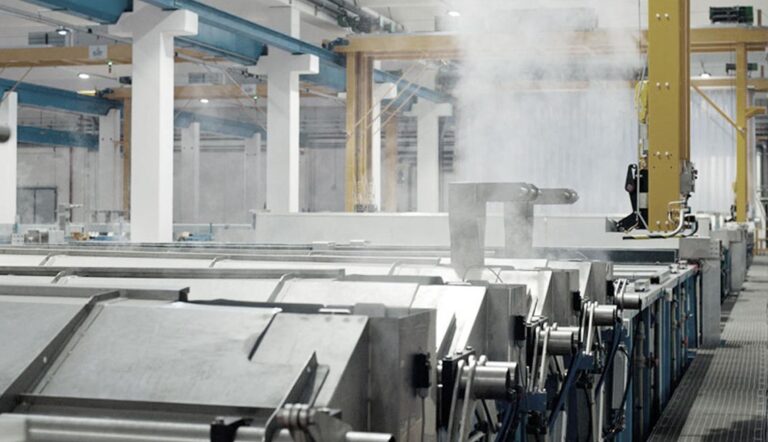
An oxide layer of protection is applied to the surface of aluminium products through the electrochemical process of aluminium anodising. The procedure is immersing the aluminium component in an electrolyte solution bath and applying an electric current to it. Aluminium oxidises as a result of the current, covering the metal in a tough layer that lasts for a long time. The type of electrolyte solution and the amount of electric current applied can be used to control the anodized layer’s thickness and colour.
Typical anodizing processes
Anodizing is an electrolytic process that is used to increase the thickness of the natural oxide layer on the surface of metal parts. Aluminium alloys are anodized to increase corrosion resistance and surface hardness, as well as to improve the adhesion and bonding of materials in further processes. The decorative electrolytic colouring process can also be applied for architectural, decorative, industrial, and aerospace applications.
Our Infrastructure
We follow a systematic approach for projects that demand high infrastructural needs. Our team of expert engineers drafts a framework keeping in mind the expectations of the clients as well as the budget. The emphasis is laid on setting up an Electroplating plant with proper planning and a strong substratum.
The conceptualization of design and master planning is done in such a way that it meets the Standard Operating Procedures without any harm to the environment. It largely involves preparing the groundwork for plant layout, manpower estimation and KPIs being the major parameters among others.